


- Home
- Industry Articles
- What Is an LED Package? Technologies, Types, Sizes, and Performance Comparison
What Is an LED Package? Technologies, Types, Sizes, and Performance Comparison

Light Emitting Diodes (LEDs) have transformed modern electronics, lighting, automotive systems, and industrial applications. Behind every high-performance LED device lies a critical yet often overlooked element: the LED package. While the semiconductor chip generates light, it is the LED package that protects, supports, enhances, and enables the chip to function reliably in real-world environments.
At GRAND HALO TECHNOLOGY CO., LTD., with over 30 years of experience in semiconductor optoelectronic sealing and packaging, we understand that packaging is the bridge between chip technology and real-world application. In this article, we share our professional insights into LED packaging technologies, types, sizes, and performance considerations from a manufacturer’s perspective.
What Is an LED Package?
An LED package refers to the complete structural assembly that houses and protects the LED semiconductor die while enabling electrical connection, thermal management, light extraction, and mechanical stability.
The LED chip itself is extremely small and fragile. Without proper encapsulation and structural support, it cannot function in practical applications. The LED package performs several essential roles:
- Protects the die from moisture, dust, and mechanical stress
- Provides electrical pathways for current flow
- Manages heat dissipation
- Shapes and enhances light output
- Ensures long-term reliability and durability
In short, the LED package determines not only how the LED operates, but also how efficiently, reliably, and safely it performs over time.
Core Components of an LED Package
Although designs vary, most LED packages include the following components:
- LED Die (Semiconductor Chip) The light-generating component, typically made from materials such as GaN or AlGaInP.
- Lead Frame or Substrate Provides electrical conduction and mechanical support. In SMD types, this may be a ceramic or metal-core substrate.
- Die Attach Material Thermally conductive adhesive or solder that bonds the die to the substrate.
- Wire Bond Fine gold or copper wires that connect the die to external leads.
- Encapsulation Material Epoxy or silicone resin that protects the die and shapes optical output.
- Optical Lens or Reflector Enhances light extraction and directs beam patterns.
The combination of these elements determines the final performance of the LED device.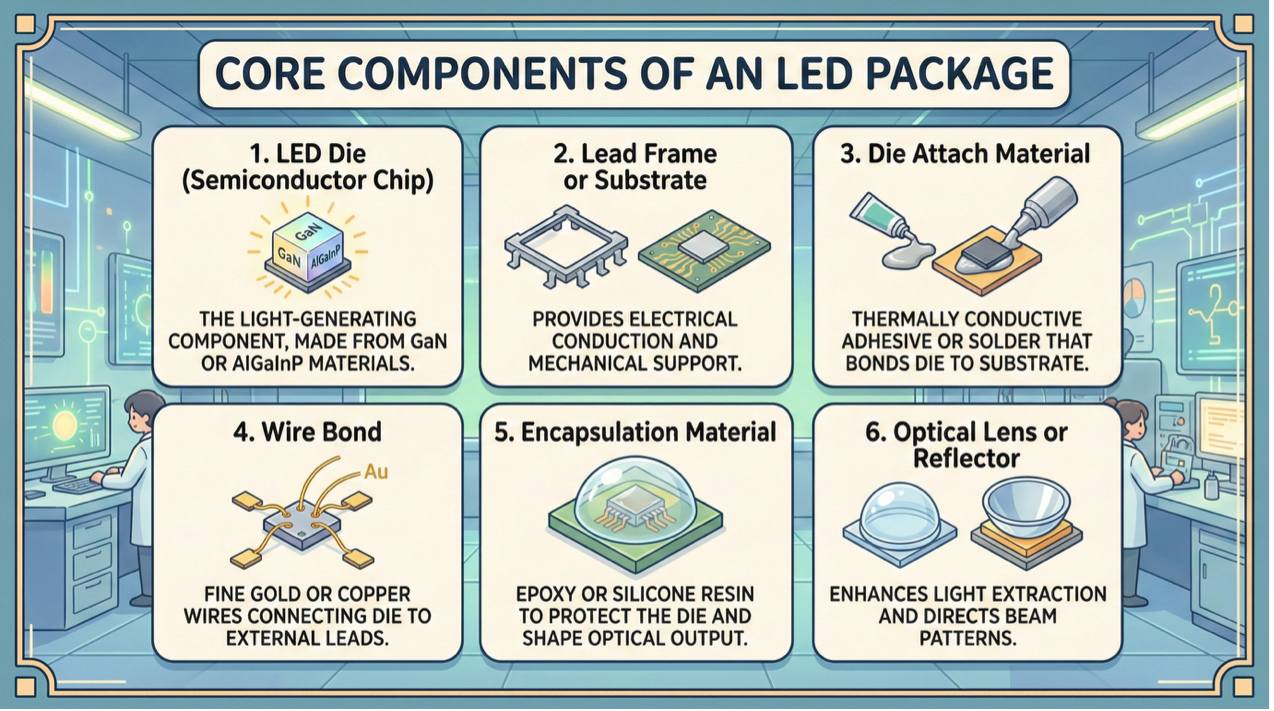
Major LED Packaging Technologies
LED packaging technologies have evolved significantly to improve brightness, heat dissipation, and miniaturization.
Through-Hole Technology (THT)
Traditional LED packages with long leads inserted into PCB holes. Common in indicator lights and legacy electronics.
Advantages:
- Simple assembly
- Strong mechanical support
- Cost-effective
Limitations:
- Larger size
- Lower packing density
- Limited thermal performance
Surface-Mount Device (SMD)
SMD LED packages are mounted directly onto the PCB surface. This is the most widely used packaging method today.
Advantages:
- Compact size
- Automated assembly compatibility
- Higher brightness density
- Better thermal management
Common SMD formats include 2835, 3528, 5050, and 5630.
Chip-on-Board (COB)
COB technology mounts multiple LED dies directly onto a substrate and encapsulates them as a single module.
Advantages:
- High luminous output
- Uniform light distribution
- Reduced thermal resistance
Applications:
- High-power lighting
- Automotive lighting
- Industrial illumination
Reflector-Type LED Packaging
This design integrates a reflective cavity to improve light direction and intensity.
Advantages:
- Enhanced luminous efficiency
- Focused beam control
- Improved optical performance
LED Package Types
LED package types are often categorized based on mounting style, structure, and application.
- SMD LED Packages Widely used in consumer electronics, display panels, and general lighting.
- Subminiature LED Packages Ultra-compact LEDs designed for portable devices and space-constrained applications.
- Casting-Type LED Packages Used in industrial environments where durability and impact resistance are required.
- Reflector-Type LED Packages Designed for applications requiring directional lighting.
- High-Power LED Packages Built with advanced thermal structures for high current operation.
Each type addresses different market needs and performance priorities.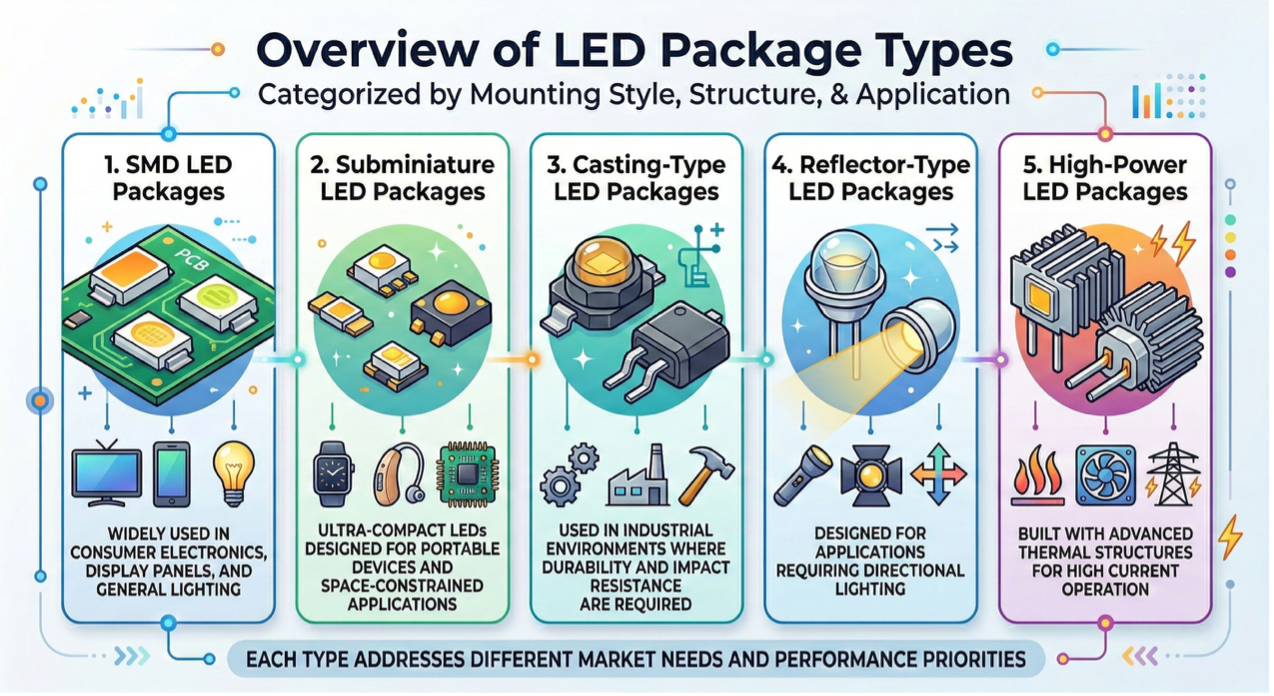
LED Package Sizes and Industry Standards
LED package sizes are typically indicated by a four-digit number representing dimensions in millimeters.
For example:
- 3528 = 3.5 mm × 2.8 mm
- 5050 = 5.0 mm × 5.0 mm
- 2835 = 2.8 mm × 3.5 mm
Smaller sizes enable higher component density and compact device design. Larger packages often allow higher power handling and improved heat dissipation.
Comparison Overview
| Package Size | Power Capacity | Heat Dissipation | Typical Application |
|---|---|---|---|
| 3528 | Low–Medium | Moderate | Displays, Indicators |
| 5050 | Medium–High | Better | RGB Lighting |
| 2835 | High Efficiency | Excellent | LED Panels, Backlighting |
Choosing the right size depends on space constraints, thermal requirements, and luminous output expectations.
Performance Comparison: What Really Matters?
When evaluating LED packages, engineers should consider the following performance factors:
Thermal Management
Heat is the primary cause of LED degradation. Packages with better thermal conductivity ensure longer lifespan and stable performance.
Luminous Efficiency
Packaging structure affects light extraction efficiency. Reflector and COB designs typically offer higher output.
Reliability and Durability
Encapsulation materials, bonding methods, and sealing techniques influence resistance to humidity, vibration, and impact.
Electrical Stability
Precise die bonding and wire bonding improve electrical performance consistency.
Miniaturization Capability
Advanced packaging enables smaller devices without sacrificing brightness.
High-quality manufacturing processes—including automatic die bonding, wire bonding, molding, auto-testing, and sorting—play a decisive role in maintaining consistent product performance.
Manufacturing Capability and Automation in LED Packaging
Modern LED packaging requires high precision and automation to achieve both quality and productivity.
Advanced production facilities typically adopt:
- Automatic Die Bonders
- Automatic Wire Bonders
- Semi-automatic molding systems
- Auto-testing and sorting equipment
- Automated taping systems
These technologies improve defect-free ratios, reduce operational cost, and ensure consistent reliability across high-volume production.
In large-scale manufacturing environments, monthly output can reach tens of millions of units while maintaining international quality standards such as ISO9001, ISO14001, and IATF16949.
Future Trends in LED Packaging
The LED packaging industry continues to evolve in response to market demands for:
- Higher luminous efficiency
- Smaller form factors
- Lower power consumption
- Enhanced durability
- Integrated optoelectronic design
Emerging materials and advanced sealing technologies are enabling better thermal control and optical performance. As portable electronics and smart devices become more compact, LED package miniaturization and integration will remain a key development focus.
Additionally, integrated photo-cell elements and solid-state circuitry are expected to shape the next phase of industry innovation.
Conclusion
An LED package is more than a structural enclosure—it is the critical interface between semiconductor technology and practical application.
From SMD to reflector types, from subminiature designs to high-output packages, the selection of LED package types and sizes directly impacts performance, efficiency, and reliability.
With over three decades of experience in semiconductor optoelectronic sealing and packaging, GRAND HALO TECHNOLOGY CO., LTD. remains committed to delivering stable, high-quality LED packaging solutions supported by advanced automation, strict quality assurance, and continuous R&D innovation.
As the industry advances, we will continue striving to provide first-class products that illuminate not only devices, but also the future of global optoelectronic applications.
Related FAQ
What is the difference between SMD and COB LED packages?
SMD (Surface-Mount Device) LED packages are individually mounted components placed directly onto a PCB surface. They are widely used in consumer electronics, display panels, and general lighting due to their compact size and automated assembly compatibility.
COB (Chip-on-Board) LED packages, on the other hand, mount multiple LED dies directly onto a substrate and encapsulate them as a single module. COB designs typically provide higher luminous output, improved thermal performance, and more uniform light distribution.
For applications requiring high brightness and concentrated output—such as industrial lighting or automotive lighting—COB may be preferred. For compact, scalable applications, SMD packages are often more suitable.
How do I choose the right LED package size?
Choosing the correct LED package size depends on several engineering factors:
- Available PCB space
- Required luminous output
- Thermal management capability
- Power consumption constraints
- Application environment
For example, smaller packages like 2835 are ideal for compact designs and backlighting applications, while larger formats such as 5050 allow higher power handling and improved heat dissipation.
The optimal LED package size balances performance, reliability, and cost efficiency for the intended application.
What factors affect LED package reliability?
LED package reliability is influenced by:
- Thermal conductivity of materials
- Quality of die bonding and wire bonding
- Encapsulation sealing techniques
- Environmental resistance (humidity, vibration, impact)
- Manufacturing process control
Advanced automation—such as automatic die bonding, wire bonding, and reliability testing—plays a critical role in maintaining consistent performance and reducing defect rates in high-volume production.
Which LED package type is best for high-power applications?
High-power LED packages are specifically designed with advanced thermal structures to handle high current operation. These packages typically include improved substrates and optimized heat dissipation paths to prevent overheating.
For applications such as industrial lighting, automotive systems, or high-output illumination, selecting a high-power LED package with strong thermal management capability is essential to ensure long-term stability and lifespan.
How does LED packaging impact LED lifespan?
Heat is the primary factor that shortens LED lifespan. A well-designed LED package effectively dissipates heat, protects against environmental stress, and maintains stable electrical performance.
Proper packaging structure, combined with strict quality control and reliable sealing technology, significantly extends service life and reduces performance degradation over time.
In practical applications, the LED package often determines durability more than the semiconductor chip itself.